

How To Draw A Three Segmented Arch
This tutorial is dedicated to solving a circular maze in TikZ  or in other words learning how to draw arcs in TikZ and as an case we consider a circular maze!
Let's get-go by presenting the arc performance!
Arc operation (office of an Ellipse)
Drawing an arc in TikZ tin be achieved past the arc opertaionwhich adds a role of an ellipse to the current path. Here is an example:
\documentclass[tikz,border=0.2cm]{standalone} \begin{certificate} \begin{tikzpicture} % Arc operation \draw (2,0) arc [ start angle=0, end angle=300, x radius=2cm, y radius =1cm ] ; \end{tikzpicture} \stop{document} 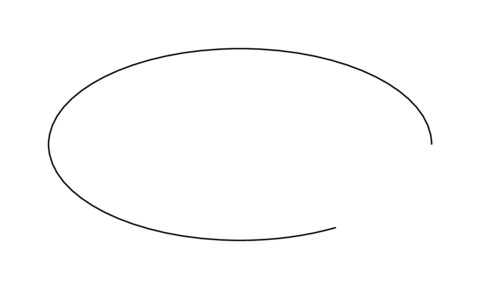
The arc starts from the signal (2,0) with 0 degree which is specified by the start angle and ends with 300 degrees which is set by theend bending.
Arc operation (part of a Circle)
To draw part of a circle, we use the same syntax as the previous i and instead of providing the parametersx-radius and y-radius,nosotros provide only the parameter radius. Here is an instance:
\documentclass[tikz,border=0.2cm]{standalone} \begin{document} \brainstorm{tikzpicture} \draw[fill=yellowish!xxx] (0,0) -- (2,0) arc[start angle=0, end angle=60,radius=2cm] -- (0,0); \draw[fill=cyan!30] (0,0) -- (0,1.five) arc [kickoff angle=90, delta angle=thirty, radius=1.5cm] -- (0,0); \draw[-latex] (120:0.5) arc (120:360:0.5) ; \end{tikzpicture} \cease{document} 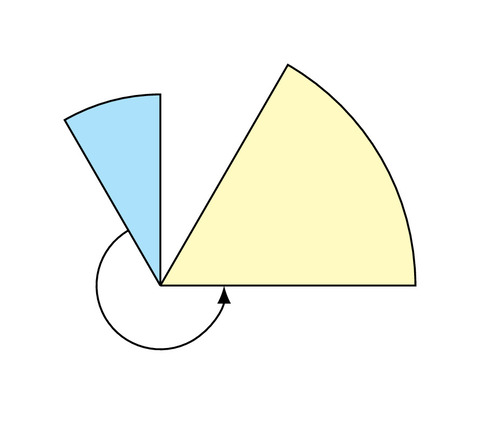
Comments:
- The yellow sector is fatigued by the arc performance and to get a part of a circle, we define only the radius instead of x radius and y radius parameters.
- The bluish sector is fatigued with the same manner as the yellow sector but in this example we have specified the delta angle instead of the end bending. The latter is equal to the start bending + delta angle.
Short Syntax of the Arc operation
The curved arrow in the previous illustration is drawn using a shorter syntax of the arc functioning:
arc(commencement angle:finish angle: radius)
which corresponds to a role of a circle. For an ellipse, we use the following syntax:
arc(offset angle:finish angle: x radius and y radius)
Still, this syntax is not intuitive and harder to read, so the normal syntax should be preferred in general (PGF transmission V.iii.one.vii.a, page 160).
Solving the maze!
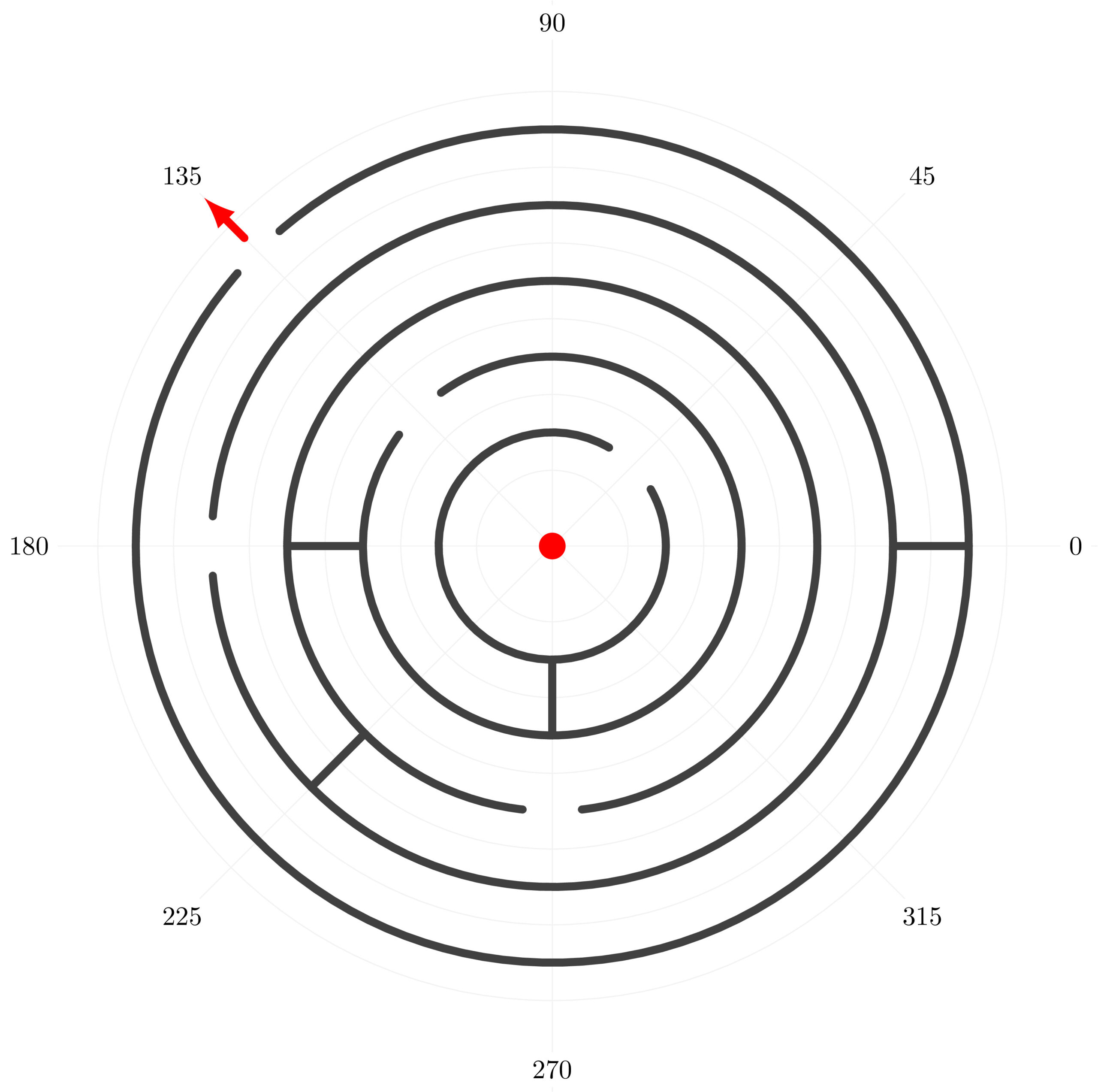
Could y'all solve the maze starting from (0,0) (center of the maze) and using the arc operation?
The solution has to be written after the comment %put hither your code in the maze TeX code. Share with us your solution using the comment section below!
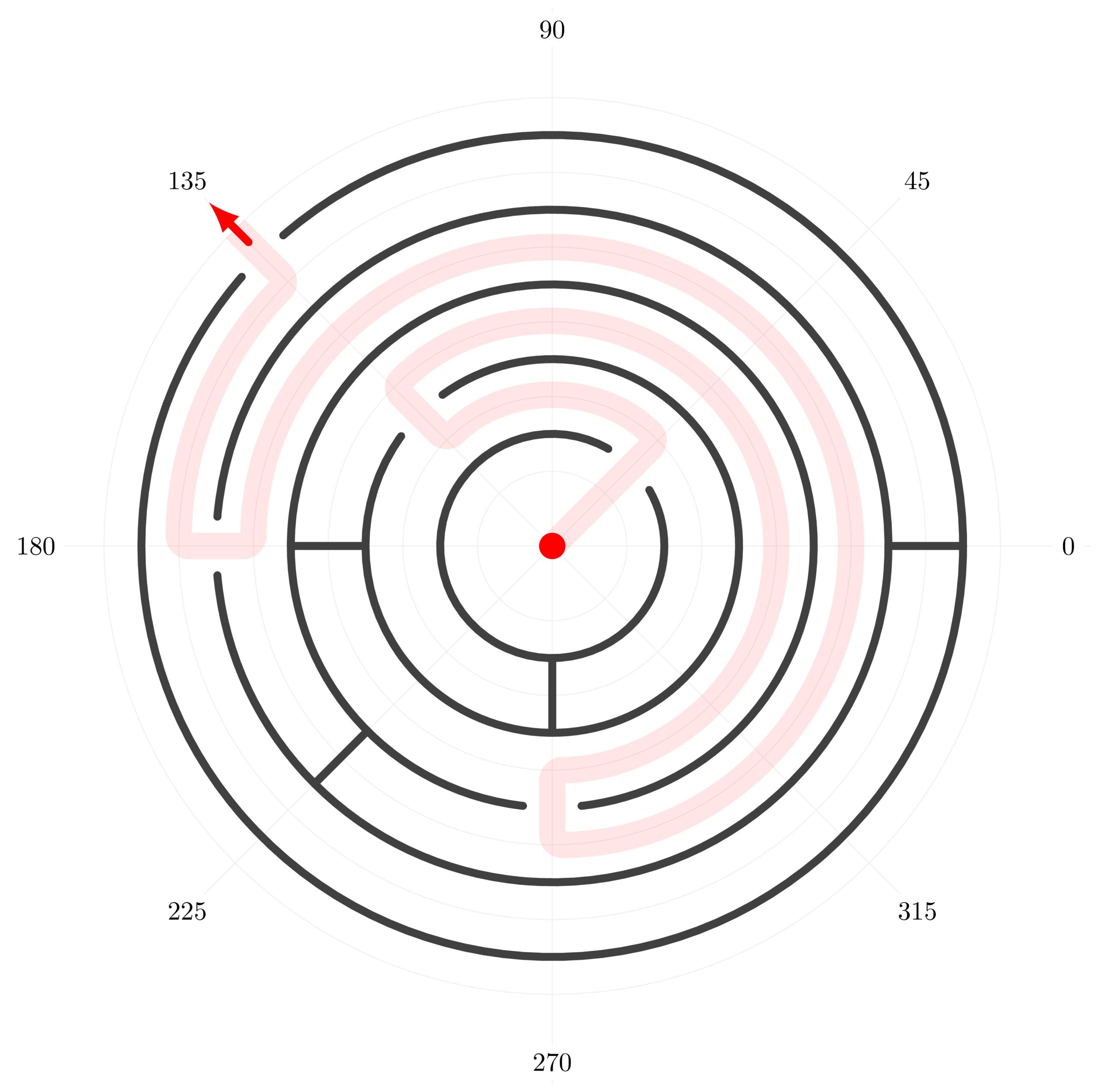
Starting from (0,0), nosotros describe a straight line to the point with polar coordinates (45:ii). From that point, we depict an arc with 45 degrees starting bending, 135 degrees end angle and radius of 2 cm. Nosotros used the brusk syntax of the arc functioning in this case.
From the finish point of the arc, we draw a direct line with polar coordinates (135:iii). From there, we draw an arc with a starting bending equals to 135 degrees and an stop angle equals to -90 degrees. We follow the aforementioned steps until nosotros attain the betoken with coordinates (135:5.75).
Here is the corresponding TikZ code:
\draw[cerise, line width=10pt, opacity=0.1, rounded corners ] (0,0) -- (45:two) arc (45:135:ii)-- (135:3) arc(135:-90:iii) -- (-90:4) arc(-ninety:180:4) -- (180:5) arc (180:135:5) -- (135:v.75);
Claiming accustomed past Overleaf!
The challenge has been accepted by Overleaf and here is their solution:
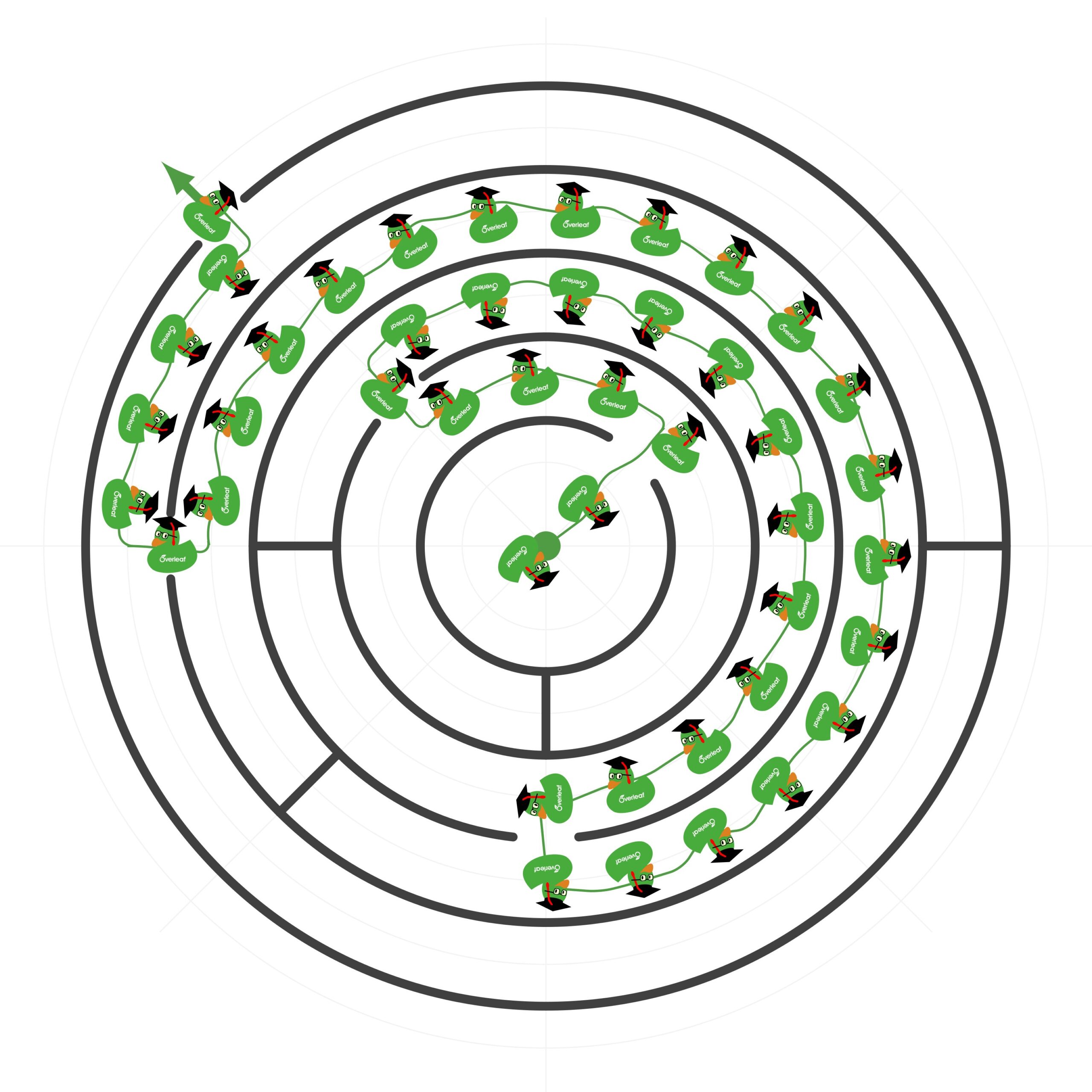
\documentclass[edge=0.5cm]{standalone} \usepackage{tikz} \usetikzlibrary{decorations.pathmorphing, decorations.markings, ducks} \definecolor{OverleafGreen}{HTML}{4F9C45} \brainstorm{document} \begin{tikzpicture} % Load the puzzle \input{Maze2} % Put your code here \tikzset{ sol1/.way = { decorate, decoration = { random steps, segment length = 0.5cm, amplitude = 0.15cm }, rounded corners = 0.15cm, color = OverleafGreen, thick, }, sol2/.style = { ornamentation = { markings, mark = between positions 0 and i pace 10.15mm with {\begin{scope}[ rotate=180, xshift=-2mm, yshift=-3.5mm, scale=0.iii]\duck[overleaf]\stop{scope} }, }, postaction = {decorate}, } } \describe[sol1] (0,0) -- (45:2) arc(45:135:two) -- (135:3) arc(135:-90:iii) -- (-xc:4) arc(-xc:180:iv) -- (180:5) arc(180:135:5) -- (135:vi); \path[sol2] (0,0) -- (45:two) arc(45:135:2) -- (135:3) arc(135:-xc:three) -- (-xc:4) arc(-ninety:180:4) -- (180:5) arc(180:135:5) -- (135:six); \stop{tikzpicture} \cease{document} 
Source: https://latexdraw.com/how-to-draw-an-arc-in-tikz/
Posted by: pritchettdout1969.blogspot.com
0 Response to "How To Draw A Three Segmented Arch"
Post a Comment