

Describe The Makeup Of The Supreme Court In 1857? Who Appointed Justice Taney?
| Taney Court | |
|---|---|
| Marshall Court ← → Chase Court | |
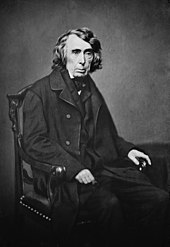 Primary Justice Roger Taney | |
| March 28, 1836 – Oct 12, 1864 (28 years, 198 days) | |
| Seat | Former Supreme Court Chamber (1836–1860) Sometime Senate Sleeping accommodation (1860–1864) Washington, D.C. |
| No. of positions | 7 (1836–1837) 9 (1837–1863) 10 (1863–1864) |
| Taney Court decisions | |
 | |
The Taney Court refers to the Supreme Court of the United States from 1836 to 1864, when Roger Taney served as the 5th Principal Justice of the United States. Taney succeeded John Marshall equally Master Justice after Marshall's death in 1835. Taney served as Chief Justice until his expiry in 1864, at which point Salmon P. Chase took office. Taney had been an of import fellow member of Andrew Jackson'due south administration, an abet of Jacksonian commonwealth, and had played a major role in the Banking company War, during which Taney wrote a memo questioning the Supreme Courtroom'south power of judicial review.[i] Yet, the Taney Court did non strongly break from the decisions and precedents of the Marshall Court, as information technology continued to uphold a strong federal regime with an independent judiciary.[2] Nearly of the Taney Court'due south holdings are overshadowed past the decision in Dred Scott v. Sandford, in which the court ruled that African-Americans could not be citizens.[3] However, the Taney Courtroom'due south decisions regarding economic problems and separation of powers fix of import precedents, and the Taney Court has been lauded for its power to adapt regulatory police to a country undergoing remarkable technological and economic progress.[4]
Membership [edit]
Taney was appointed Chief Justice past President Andrew Jackson, who filled a vacancy caused past the death of Chief Justice John Marshall in 1835. Jackson had previously nominated Taney to fill a vacancy caused past the retirement of Gabriel Duvall, just Taney's appointment for that seat was non voted on by the Senate. Duvall'southward seat was instead filled past Philip P. Barbour in 1836. After the confirmation of Barbour, the Taney Courtroom consisted of Taney, Barbour, and five Associate Justices from the Marshall Court: Joseph Story, Smith Thompson, John McLean, Henry Baldwin, and James Moore Wayne. Jackson appointed John Catron to the bench in 1837 afterwards Congress increased the size of the Supreme Court to ix seats. The same yr, President Martin Van Buren filled the other newly created seat with the engagement John McKinley. Van Buren also appointed Peter Vivian Daniel in 1841 after the death of Barbour. Thompson died in 1843, but President John Tyler was unsuccessful in his attempts to make full the seat. However, Tyler was able to nominate Samuel Nelson right before leaving office, and soon after, President James M. Polk successfully nominated Levi Woodbury a short fourth dimension afterwards taking role, replacing Thompson and Story. Polk also appointed Robert Cooper Grier, replacing Baldwin; the vacancy acquired by Baldwin's death is the longest in Supreme Courtroom history.[five]
Millard Fillmore appointed Benjamin Curtis to replace Woodbury in 1851; Curtis is the just Whig-appointed Justice in American history and is the last justice who was not appointed past a fellow member of the Autonomous or Republican parties. President Franklin Pierce appointed John Archibald Campbell in 1853, replacing McKinley. Curtis resigned from the court following the 1857 Dred Scott conclusion, and President James Buchanan appointed Nathan Clifford as his replacement. At the outset of the Civil War, Campbell resigned from the court to serve as a Confederate official. McLean and Daniel also died effectually the same fourth dimension. In 1862, President Abraham Lincoln appointed Noah Haynes Swayne (the first Republican-appointed justice in history), Samuel Freeman Miller, David Davis to replace them. Lincoln also appointed Stephen Johnson Field to a newly created seat. Taney died in 1864, and Lincoln appointed Salmon P. Chase as the new Chief Justice. The Taney Court is notable for its long vacancies, as the iii longest vacancies in courtroom history all occurred during Taney's tenure as Primary Justice.[5]
Timeline [edit]
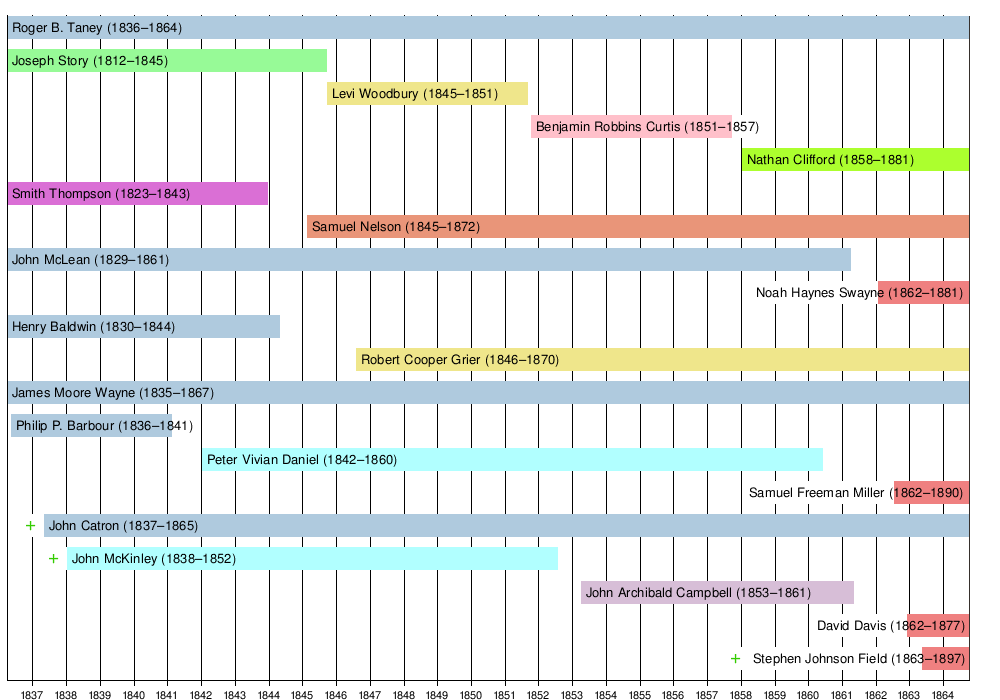
Note: + denotes new seat
Bar key:
Madison appointee
Monroe appointee
J. Q. Adams appointee
Jackson appointee
Van Buren appointee
Tyler appointee
Polk appointee
Fillmore appointee
Pierce appointee
Buchanan appointee
Lincoln appointee
Other branches [edit]
Presidents during this court included Andrew Jackson, Martin Van Buren, William Henry Harrison, John Tyler, James Grand. Polk, Zachary Taylor, Millard Fillmore, Franklin Pierce, James Buchanan, and Abraham Lincoln. Congresses during this court included 24th through the 38th United States Congresses.
Rulings of the Court [edit]
The Taney Courtroom issued several major rulings during its tenure, including:[six]
- Charles River Bridge 5. Warren Bridge (1837): In a conclusion delivered past Chief Justice Taney, the courtroom upheld Massachusetts'south granting of a lease to construct a bridge over the Charles River. The plaintiff, Charles River Span Company, endemic another bridge on the river, and sued the state, arguing that Massachusetts was breaking a charter it had given the plaintiff in the 18th century. The court held that there was no violation of the Contract Clause, and also set an important precedent for a country's power to promote the general welfare of its people.[7]
- Luther five. Borden (1849): In a conclusion written past Chief Justice Taney, the court refused to arbitrate in the Dorr Rebellion. The plaintiffs alleged that Rhode Island's regime violated the Guarantee Clause considering it was not republican in nature. The courtroom held that the case was a non-justiciable political question, and that it is Congress's office to decide whether a state's government qualifies equally "republican."[8]
- Cooley v. Board of Wardens (1852): In a determination delivered by Justice Curtis, the courtroom upheld a Pennsylvania police requiring vessels leaving Philadelphia to use a local pilot or pay a fine. In the decision, the court set an of import precedent regarding the Commerce Clause, charting a middle course between federal and state ability. The decision gave states the ability to brand some laws affecting interstate commerce, using a balancing test to determine whether state interests outweighed federal interests in compatible laws.[9]
- Dred Scott v. Sandford (1857): In a 7–2 decision in which all ix justices wrote an opinion, Chief Justice Taney wrote the bulk stance. The court dismissed the plaintiff'southward suit, and held that the plaintiff remained a slave of the defendant. More chiefly, the courtroom also declared that no African-Americans (including free blacks) qualified every bit citizens of the United states of america, and that Congress did not have the power to ban slavery from the territories. The decision was strongly condemned past opponents of slavery, and was largely overturned past the Fourteenth Amendment.
- Ableman v. Berth (1859): In a unanimous determination written by Chief Justice Taney, the court held that federal courts have terminal say over issues of federal constabulary, and thus state courts have no right to nullify federal court decisions regarding federal constabulary.
For a full listing of decisions by the Taney Court, run into lists of U.s.a. Supreme Court cases past book, volumes 36 through 68.
See also [edit]
- Aboriginal title in the Taney Court
- Criminal police force in the Taney Court
References [edit]
- ^ Schwartz, Bernard (1993). A History of the Supreme Courtroom. New York: Oxford University Printing. pp. 71–72.
- ^ Schwartz, 73-74
- ^ "Roger Taney". The Supreme Court. PBS. Retrieved x March 2016.
- ^ Huebner, Timothy S. (2003). The Taney Court: Justices, Rulings, and Legacy. ABC-CLIO. pp. 175–176, 185–186. ISBN9781576073681 . Retrieved 10 March 2016.
- ^ a b Desilver, Drew (26 February 2016). "Long Supreme Courtroom vacancies used to be more common". Pew. Retrieved 10 March 2016.
- ^ Schwartz, 69-105
- ^ Schwartz, 75-77
- ^ Schwartz, 95-96
- ^ Schwartz, 84-88
Farther reading [edit]
Works on the Taney Courtroom [edit]
- Allen, Austin (2010). Origins of the Dred Scott Case: Jacksonian Jurisprudence and the Supreme Court, 1837-1857. University of Georgia Press. ISBN9780820336640.
- Huebner, Timothy S. (2010). "Roger Taney and the Slavery Consequence: Looking Beyond—and Before—Dred Scott". Journal of American History. 97 (1): 39–62. doi:10.2307/jahist/97.1.17. JSTOR 40662816.
- Huebner, Timothy Due south. (2003). The Taney Court, Justice Rulings and Legacy. ABC-CLIO. ISBN1-57607-368-viii.
- Maltz, Earl M. (2009). Slavery and the Supreme Court, 1825-1861. Academy Press of Kansas. ISBN9780700616664.
- Simon, James F. (2006). Lincoln and Principal Justice Taney: Slavery, Secession, and the President's War Powers (Paperback ed.). Simon & Schuster. ISBN0-7432-9846-2.
- Streichler, Stuart (2005). Justice Curtis in the Ceremonious War Era: At the Crossroads of American Constitutionalism. University of Virginia Press. ISBN9780813923420.
Other relevant works [edit]
- Abraham, Henry Julian (2008). Justices, Presidents, and Senators: A History of the U.S. Supreme Court Appointments from Washington to Bush II. Rowman & Littlefield. ISBN9780742558953.
- Cushman, Clare (2001). The Supreme Court Justices: Illustrated Biographies, 1789–1995 (2nd ed.). (Supreme Court Historical Lodge, Congressional Quarterly Books). ISBN1-56802-126-7.
- Friedman, Leon; State of israel, Fred 50., eds. (1995). The Justices of the United States Supreme Courtroom: Their Lives and Major Opinions. Chelsea Firm Publishers. ISBN0-7910-1377-4.
- Hall, Kermit 50.; Ely, Jr., James W.; Grossman, Joel B., eds. (2005). The Oxford Companion to the Supreme Courtroom of the U.s.a. (2nd ed.). Oxford University Press. ISBN9780195176612.
- Hall, Kermit L.; Ely, Jr., James West., eds. (2009). The Oxford Guide to United states of america Supreme Court Decisions (second ed.). Oxford University Printing. ISBN978-0195379396.
- Hall, Timothy L. (2001). Supreme Court Justices: A Biographical Dictionary. Infobase Publishing. ISBN9781438108179.
- Hoffer, Peter Charles; Hoffer, WilliamJames Hull; Hull, Northward. Due east. H. (2018). The Supreme Court: An Essential History (2nd ed.). University Press of Kansas. ISBN978-0-7006-2681-6.
- Howe, Daniel Walker (2007). What Hath God Wrought: The Transformation of America, 1815–1848. Oxford History of the Usa. Oxford University Press. ISBN978-0-19-507894-7.
- Irons, Peter (2006). A People's History of the Supreme Court: The Men and Women Whose Cases and Decisions Have Shaped Our Constitution (Revised ed.). Penguin. ISBN9781101503133.
- Martin, Fenton South.; Goehlert, Robert U. (1990). The U.S. Supreme Court: A Bibliography. Congressional Quarterly Books. ISBN0-87187-554-iii.
- McGinty, Brian (2009). Lincoln and the Courtroom. Harvard Academy Press. ISBN9780674040823.
- Tomlins, Christopher, ed. (2005). The United States Supreme Courtroom: The Pursuit of Justice. Houghton Mifflin Harcourt. ISBN978-0618329694.
- Urofsky, Melvin I. (1994). The Supreme Court Justices: A Biographical Dictionary. Garland Publishing. ISBN0-8153-1176-1.
Source: https://en.wikipedia.org/wiki/Taney_Court
Posted by: pritchettdout1969.blogspot.com
0 Response to "Describe The Makeup Of The Supreme Court In 1857? Who Appointed Justice Taney?"
Post a Comment