

how to draw feet and shoes
Feet and easily are likely the two nearly avoided torso parts by beginning artists. Sure, any bit of human anatomy presents a set of challenges, but easily and feet are considered past some to be the "hardest to draw".
Some folks will even go to nifty lengths to avoid cartoon feet. They may purposely exit them out of a drawing or cover them upwardly with overgrown grass blades.
But drawing feet is just like drawing whatsoever other field of study. We just need to notice the feet and wait for bones shapes and forms to draw. When we find them and depict them first, the contour lines are much easier to depict. With a bit of value and tone, the texture and form of the feet can exist developed.
The following video explains a unproblematic arroyo to drawing anxiety. This approach uses three basic forms that anyone can draw. When these three forms are recognized and pieced together, the process becomes much easier.
Don't Over Think Drawing Feet
The human body is a complex field of study. The os structure and muscles underneath the pare play a office in the subtle changes of tone that affect the representational qualities of the drawing. Knowing the anatomical construction certainly helps, but it'south not required knowledge to draw a convincing pes.
We can simplify the process by recognized iii bones forms. These bones forms can exist establish on whatsoever foot in just about whatever position. If nosotros do recognizing these forms and drawing them, then drawing feet really becomes a much easier effort.
The Wedge
The get-go bones form is peradventure the easiest to recognize. It is the wedge that exists in the middle portion of the pes. Typically, this is the first class that is drawn since the other ii forms extend off from information technology. This wedge form makes up the bulk of the human foot and it helps to determine the angle and direction of the rest of the foot.
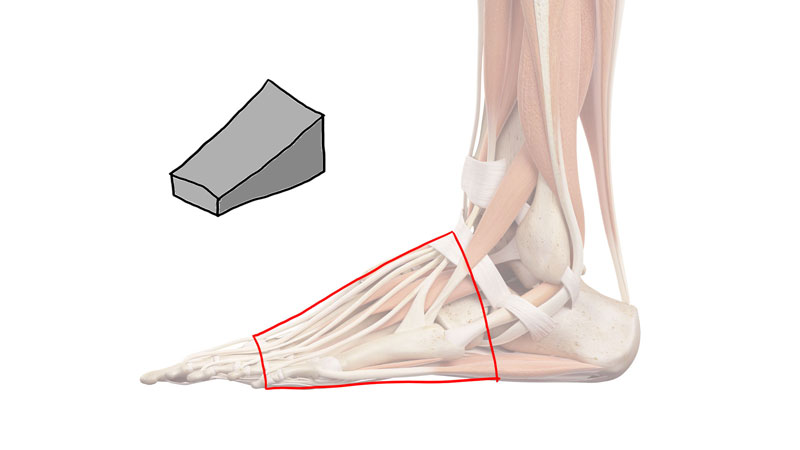
This wedge is taller towards the heel and slants downwardly toward the toes. When drawing these basic forms, you lot tin be loose with the lines that you draw. Nosotros'll refine the edges and the contours once we have all of the basic forms in identify.
The Toes
The second form is drawn in the location of the toes. This form connects with the end of the wedge and resembles a flattened, fractional cylinder. If the toes are viewed from the front or directly from the side, this form may appear every bit a unproblematic rectangle.
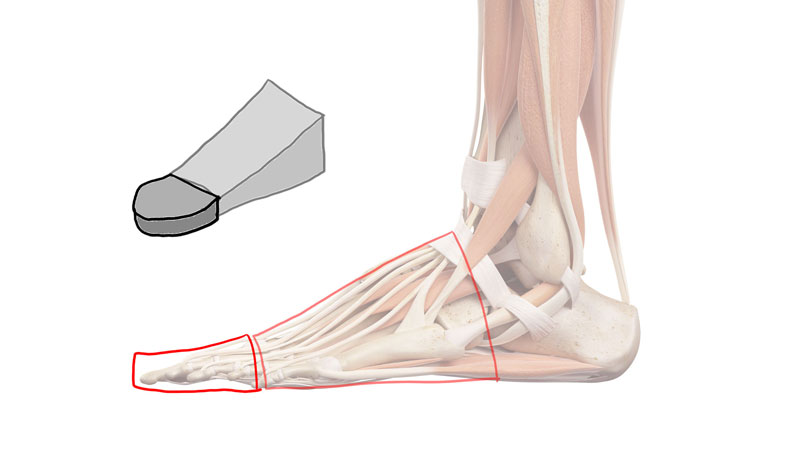
You may think of this class as the finish of a shoe, which makes perfect sense. Remember, at this stage of the drawing, we are merely concerned with these simple forms. Be sure that your aren't distracted by the details. We'll add the details after these forms are in identify.
The Heel
The tertiary form is for the heel of the foot. This forms extends from the contrary finish of the wedge. Information technology is a much taller partial cylinder that is flattened on the sides.
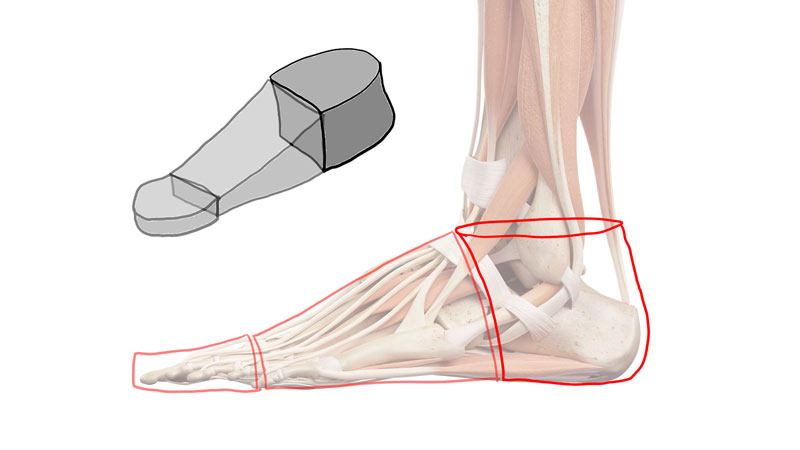
Once we have the basic forms in place, nosotros tin next turn our attention to defining the contour lines or outlines. If we started with the contours, and then nosotros are more likely to see issues with accuracy.
Bones Forms From Any Angle
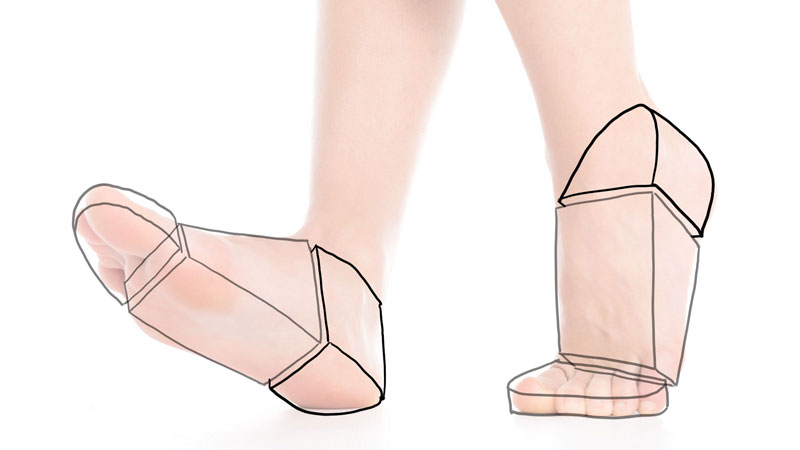
These three basic forms can be recognized and drawn when the foot is in whatsoever position. The forms may change slightly depending on the specific angle, but they are still easy to find.
Drawing The Contours
The profile lines or outlines define the edges of the feet. These lines tin can exist drawn with added confidence considering we now have the overall form of the foot in place. We can pay closer attention to the subtle curves and bumps that occur.
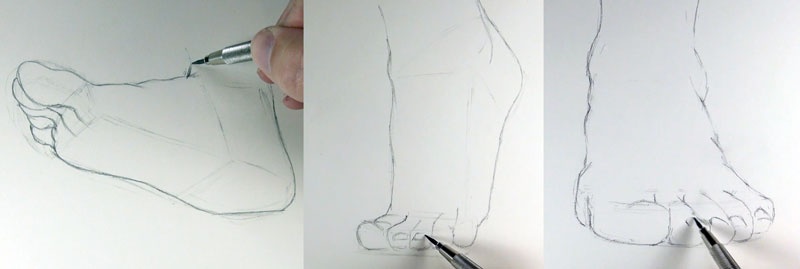
The toes fit nicely in the form that we have drawn for them. The line where the wedge meets the form can also be used as a guideline for where the toes run into the middle portion of the pes. In nearly circumstances, this line curves slightly. The second toe unremarkably extends out the most. The toes then become shorter making their mode back to the wedge.
Developing the Form of the Foot
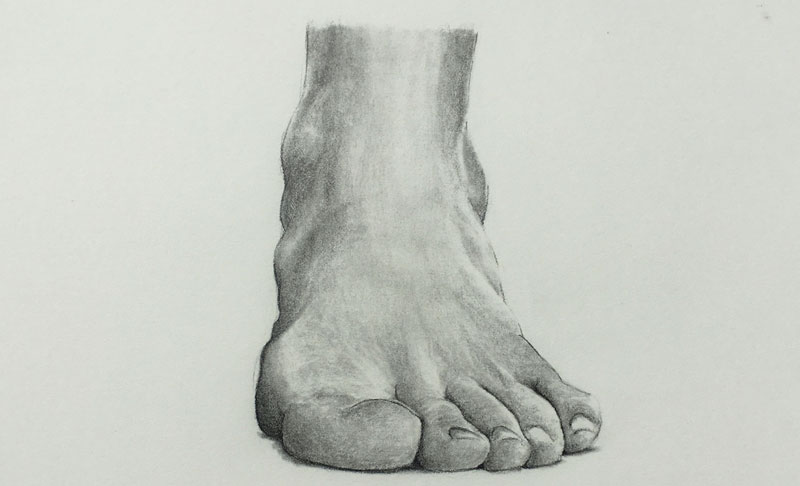
The illusion of form is created through the development of a range of value. Nosotros frequently refer to this part of the process as shading. We aren't just because the shades though, but also the lighter values. The positioning of these tones creates the illusion of the light source, which informs the viewer of the form.
In each i of these examples, we are faced with dual light sources. (In well-nigh circumstances, there is more than i light source.) We have a dominant light source that originates from the right and a weaker one that originates from the left. This produces stronger highlights on the right side and stronger shadows on the left.
We can likewise consider that in most situations, areas that recede away from the viewer are typically darker in value, while locations that protrude towards the viewer selection up more than light and are lighter in value. This ways that fifty-fifty on the side of the foot that is closest to the dominant light source, we notice some areas of darker tone.
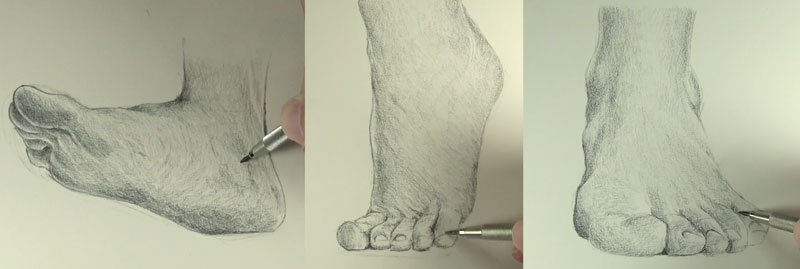
Every bit the graphite is applied to the drawing with a pencil, nosotros'll need to consider the class of the pes. Directional strokes should flow effectually the surface in a manner that mimics the form. These directional strokes are not unlike cantankerous profile lines. By adding the graphite in this way, we are addressing not but the tonality, but likewise the course.
Developing Texture
The texture of the foot is developed past smoothing transitions of tone and value with the use of a blending stump. The directional strokes made with the blending stump should mimic those made with the pencil. As the form changes, the stroke should as well.
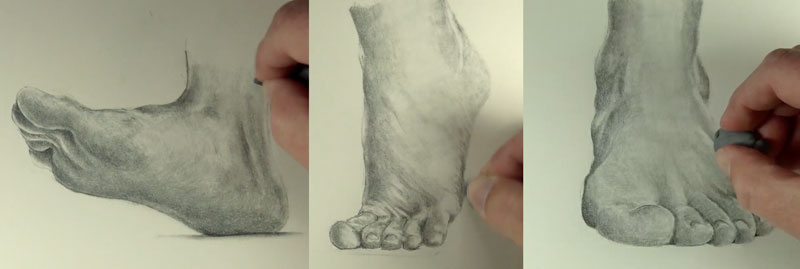
Lighter values and highlights can be pulled or lifted from the surface with a kneaded eraser. The combination of smoothing graphite applications and removing bits of highlight with the kneaded eraser often leads to a convincing illusion of skin.
Strengthening The Contour Lines
Afterwards the tones and texture take been addressed, we tin strengthen the contrast and refine the edges with a sharpened graphite pencil. Around the edges, only the areas of darker value are reinforced with additional lines.
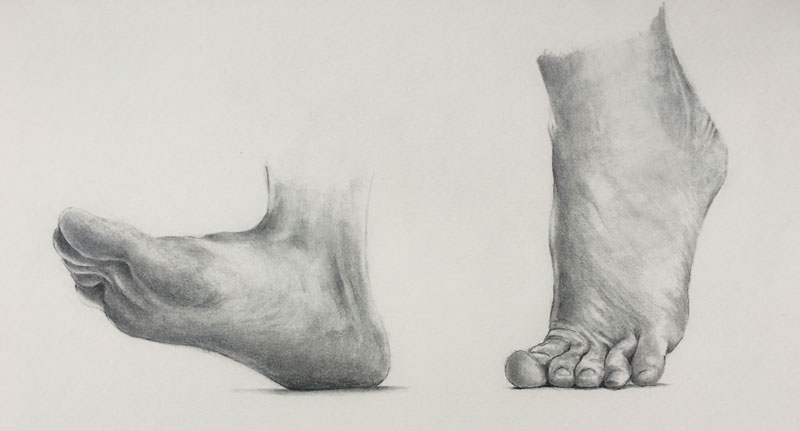
Edges of the foot that are highlighted are left open with unsaid lines defining the edge. These concluding few lines consummate the cartoon.
Summing It Up
Drawing feet doesn't accept to be hard. We can remove many of the complexities by only learning to recognize the basic forms that are present. By drawing these forms loosely in the commencement stages of the drawing, we are free to focus on the contour lines with confidence. With the profile lines in identify, all that's left to do is add a bit of value and texture.

Source: https://thevirtualinstructor.com/how-to-draw-feet.html
Posted by: pritchettdout1969.blogspot.com
0 Response to "how to draw feet and shoes"
Post a Comment