

How To Determine Scale Of Drawing
3 Scale drawings
Have you always drawn a plan of a room in your house to help you work out how to rearrange the piece of furniture? Or maybe you've sketched a program of your garden to assist you decide how big a new patio should be?
These pictures are called scale drawings. The of import thing with calibration drawings is that everything must be drawn to scale, meaning that everything must be in proportion – that is, 'shrunk' past the same amount.
All scale drawings must take a scale to tell us how much the drawing has been shrunk by.
Case study _unit5.iii.1 Case: In the garden
Here is an example of typical scale cartoon:
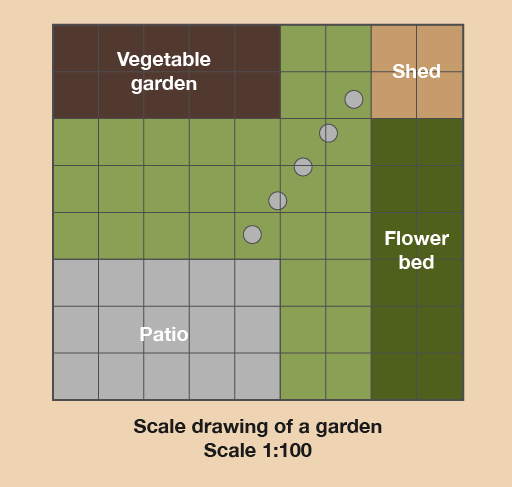
Effigy _unit5.iii.1 Figure xvi A scale drawing of a garden
What'south the width and length of the patio?
Box _unit5.3.1
Hint: This calibration cartoon has been fatigued on squared paper. This makes it easier to draw and understand. Each square is 1 cm wide and 1 cm long. Then instead of using a ruler you can merely count the squares and this will tell you the measurement in centimetres.
Method
The scale in this drawing is 1:100. This means that 1 cm on the scale cartoon is equal to 100 cm, or 1 g, in real life. Once we know the calibration, we can measure the distances on the drawing.
Using a ruler (or only counting the squares), we notice that the patio is 5 cm long and three cm wide on the cartoon. This ways that in real life it is 5 metres long and iii metres wide.
And then when you're working with calibration drawings:
- Find out what the calibration on the cartoon is.
- Measure the distance on the cartoon using a ruler (or count the number of squares, if that's an choice).
- Multiply the distance you measure past the calibration to give the distance in real life.
Now try the post-obit action. Recollect to bank check your answers once you take completed the questions.
Activity _unit5.3.1 Action 6: Getting information from a scale drawing
- Let'southward stay with this scale drawing of the garden.
Figure _unit5.three.2 Figure 17 A scale drawing of a garden
- a.What is the width and length of the vegetable garden?
- b.What is the width and length of the flower bed?
- c.How far is the patio from the vegetable garden?
- d.Say you wanted to put a trampoline between the patio and the vegetable garden. It measures 3 thou by three g. Is there enough space for it?
- A landscaper wants to put a wild surface area in your garden. She makes a scale plan of the wild area:
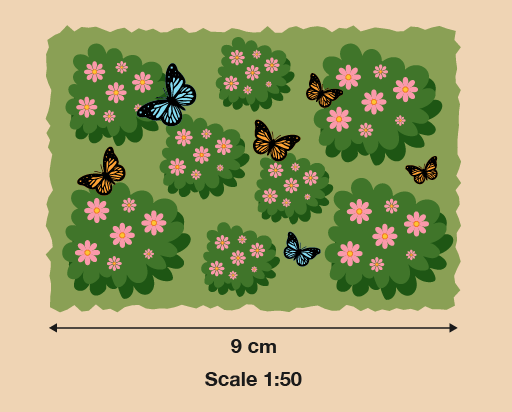
Figure _unit5.3.3 Effigy 18 A calibration drawing of a wild surface area of a garden
What is the length of the longest side of the bodily wild area in metres?
- Here is a scale cartoon showing one disabled parking infinite in a supermarket car park. The supermarket plans to add 2 more disabled parking spaces next to the existing ane, with no spaces between them.
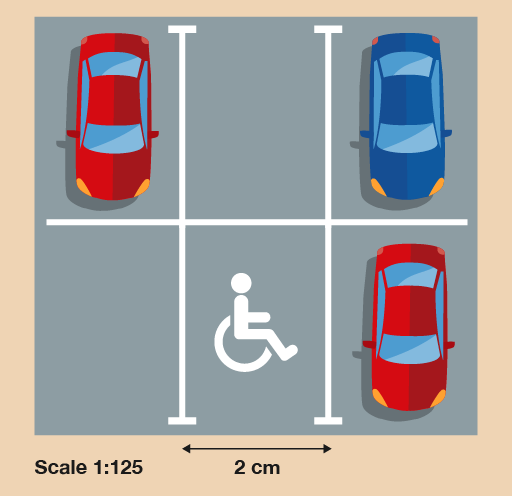
Effigy _unit5.3.4 Figure 19 A scale cartoon of a machine park
What will be the total bodily width of the three disabled parking spaces in metres?
Reply
- The answers are equally follows:
- a.The vegetable garden is v one thousand long and two m wide.
- b.The bloom bed is 6 m long and two m wide.
- c.The patio and vegetable garden are three yard autonomously.
- d.The distance between the patio and vegetable garden is 3 m and the trampoline is 3 k broad. So the trampoline would fit in the space, but information technology would be a bit of a clasp.
-
The length on the drawing is nine cm, and the scale is 1:50. This means that 1 cm on the cartoon is equal to 50 cm in existent life. And then to find out what 9 cm is in real life, you need to multiply it by fifty:
- nine × 50 = 450 cm
The question asks for the length in metres, so you need to convert centimetres into metres:
- 450 ÷ 100 = iv.v 1000
The actual length of the wild area will be 4.5 m.
-
You need to find out the width of three disabled parking spaces. The width of one parking space on the calibration drawing is ii cm, then offset you need to multiply this by iii:
- 2 × three = 6 cm
The scale is 1:125. This means that 1 cm on the cartoon is equal to 125 cm in real life. And then to find out what half-dozen cm is in existent life, you demand to multiply it by 125:
- 6 × 125 = 750 cm
The question asks for the length in metres, so you need to catechumen centimetres into metres:
- 750 ÷ 100 = seven.v 1000
The actual width of all iii parking bays will exist 7.5 m.
Summary
In this section you have learned how to utilise scale drawings.

Source: https://www.open.edu/openlearn/ocw/mod/oucontent/view.php?id=83812§ion=_unit5.3
Posted by: pritchettdout1969.blogspot.com
0 Response to "How To Determine Scale Of Drawing"
Post a Comment