

Gtx 1070 Ti Power Draw
Power, Temperature, & Noise
As always, we'll take a look at inter-related metrics of power, temperature and noise. Particularly with noise, these factors can render unwanted even a decently-performing card, a situation that usually goes hand-in-hand with high power consumption and heat output. As this is a new GPU, we will quickly review the GeForce GTX 1070 Ti's stock voltages as well.
| GeForce Video Card Voltages | |||||
| GTX 1070 Ti Boost | GTX 1070 Boost | GTX 1070 Ti Idle | GTX 1070 Idle | ||
| 1.062v | 1.062v | 0.65v | 0.625v | ||
With the exception of a slightly higher idle voltage, everything remains the same in comparison to the GTX 1080 and 1070. The idle voltage actually matches the GTX 1080 Ti idle voltage, but isn't particularly significant as it seems to vary from card to card. In comparison to previous generations, these voltages are exceptionally lower because of the FinFET process used, something we went over in detail in our GTX 1080 and 1070 Founders Edition review. As we said then, the 16nm FinFET process requires said low voltages as opposed to previous planar nodes, so this can be limiting in scenarios where a lot of power and voltage are needed, i.e. high clockspeeds and overclocking.
Fortunately for NVIDIA, GP104 has always been able to clock exceptionally high, at least the good chips, so with a slight knock on efficiency in the form of a 180W TDP, the GTX 1070 Ti Founders Edition is also able to clock exceptionally high, and then a little more. I also suspect the maturity of TSMC's 16nm FinFET process is playing a part here, but the card's higher TDP and NVIDIA's clockspeed choices make it hard to validate that point.
| GeForce Video Card Average Clockspeeds | |||
| Game | GTX 1070 Ti | GTX 1070 | |
| Max Boost Clock | 1898MHz | 1898MHz | |
| Battlefield 1 | 1826MHz | 1797MHz | |
| Ashes: Escalation | 1838MHz | 1796MHz | |
| DOOM | 1856MHz | 1780MHz | |
| Ghost Recon Wildlands | 1840MHz | 1807MHz | |
| Dawn of War III | 1848MHz | 1807MHz | |
| Deus Ex: Mankind Divided | 1860MHz | 1803MHz | |
| Grand Theft Auto V | 1865MHz | 1839MHz | |
| F1 2016 | 1840MHz | 1825MHz | |
| Total War: Warhammer | 1832MHz | 1785MHz | |
The end result is that the GTX 1070 Ti is amusingly able to reverse the GeForce Founders Edition trend of decreased clocks with higher-performing models; that is, as we reviewed them, the GTX 1080 Ti maintained lower clockspeeds than the GTX 1080, which in turn had lower average clockspeeds than the vapor-chamberless GTX 1070, which had lower clockspeeds than the GTX 1060. Typically, that was the case due to extra hardware units, and thus extra power consumption and heat. But as we see in the GTX 1070 Ti Founders Edition, despite the extra SMs and such, the vapor chamber and higher TDP work well in allowing the GTX 1070 Ti to boost high. In fact, higher than the GTX 1070 FE across the board, but in relative terms the clockspeeds only come out to about 2% faster on average than the GTX 1070 FE. In relation to the 1683MHz boost specification, the GTX 1070 Ti on average clocks nearly 10% above that in these games, though that is something we've already seen with previous Pascal cards. And we can also start to see the line of thinking that leads to framing the GTX 1070 Ti as an "overclocking monster."
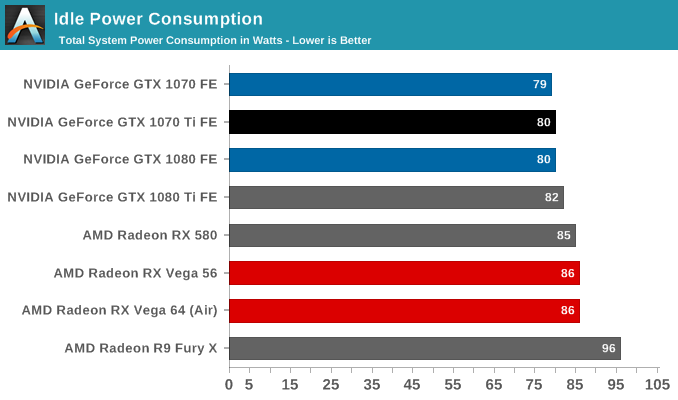
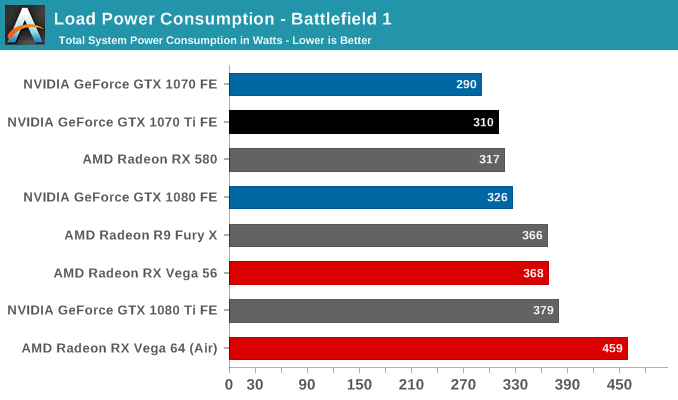
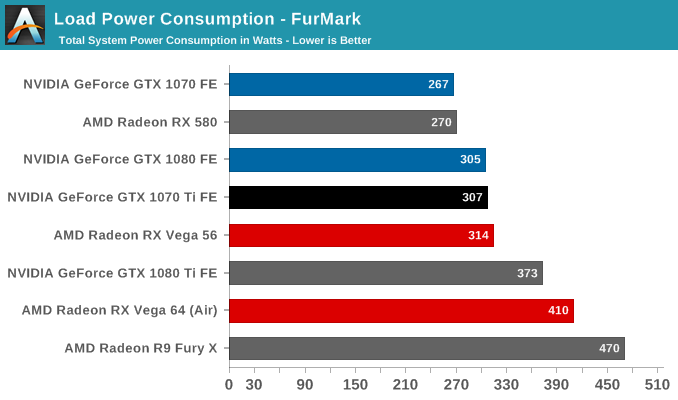
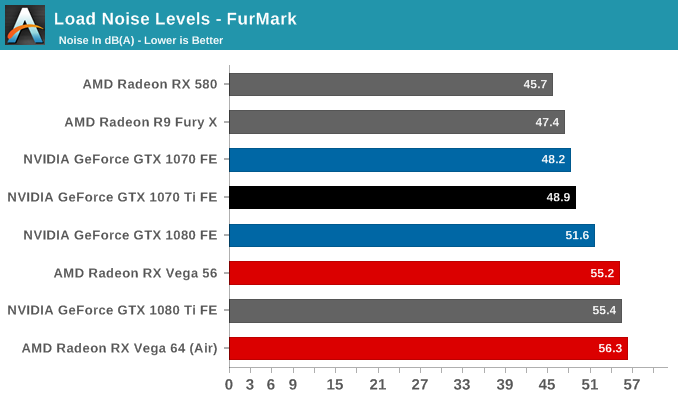
As those higher clockspeeds bear out in power, heat, and noise, there are no surprises here with the GTX 1070 Ti Founders Edition. We've already seen several variations in the aforementioned Founders Edition cards. Here, the blower and vapor chamber are more than adequate for what the card can put out, and in turn lessening the work (and noise) the fan needs to do.
Given the higher 180W TDP, the card can also be closer to GTX 1080 levels of power consumption if need be, though with measurements at the wall, the accuracy of quantification is less than ideal. But in any case, the GTX 1070 Ti has no real necessity to be a power-sipper at this performance range, for which the crown has already gone to the GTX 1070. On top of that, drops in power efficiency will likely not be noticable when compared to its RX Vega competition, or even just against RX Vega 56, whose Battlefield 1 power consumption at the wall is closer to the GTX 1080 Ti FE than the GTX 1080, let alone the GTX 1070 Ti FE.
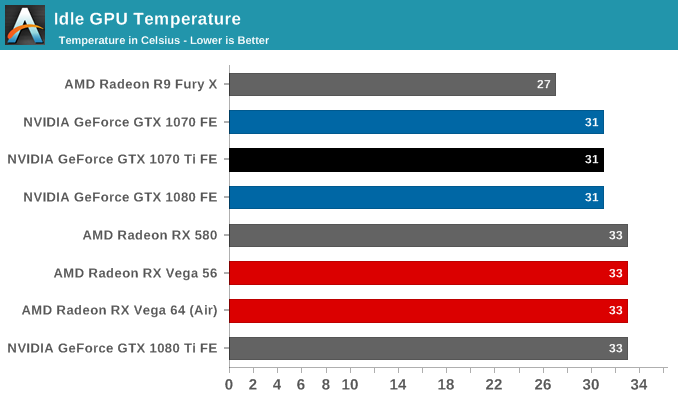
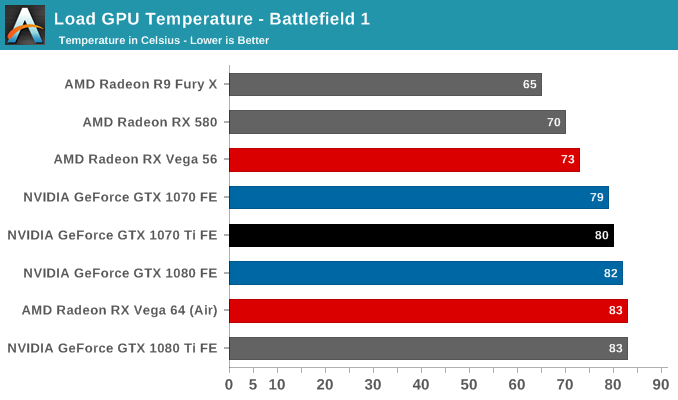
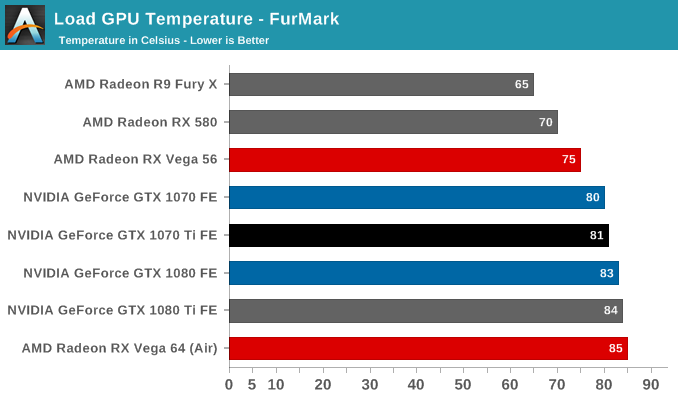
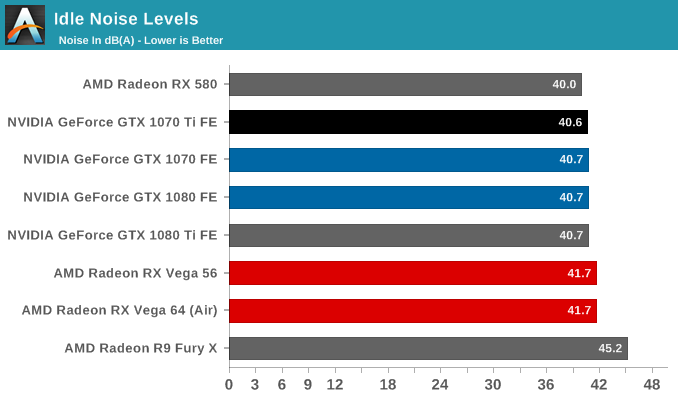
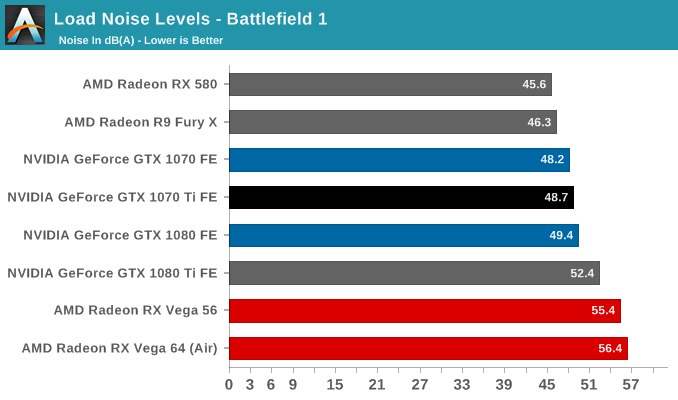
As far as heat and noise go, the GTX 1070 Ti FE has the same 83C throttle point as the GTX 1080 and 1070 FEs, and will approach there under load, though with the GTX 1080's vapor chamber cooler, is kept a little cooler. This follows in fanspeeds and noise as well, and particularly in the eternal power-virus that is Furmark. So for both temperature and noise, the GTX 1070 Ti FE sits right in between the GTX 1080 and 1070 FEs.
Synthetics Overclocking
Gtx 1070 Ti Power Draw
Source: https://www.anandtech.com/show/11987/the-nvidia-geforce-gtx-1070-ti-founders-edition-review/15
Posted by: pritchettdout1969.blogspot.com
0 Response to "Gtx 1070 Ti Power Draw"
Post a Comment